Carboniferous
Velatomorpha Altilis
Geological time:
Upper Carboniferous (Copeland, 1957)
Location:
Nova Scotia, Joggins Formation (Tibert & Dewey, 2006)
Information:
- Females are short and stout, while males are long and angular (Tibert & Dewey, 2006)
- Thrive in estuarine environment
- Molt their smooth shell multiple times in their lifetime
- Belong to the class Ostracoda, which are sometimes referred to as microfossils because of their small size (Maloney, 2016)
History:
- Most abundant of ostracodes in Joggins Formation; appear in nearly all samples
- Velatomorpha altilis was originally deemed to be Carbonita altilis, but later was assigned to its own genus based on internal features that did not match the diagnostic characteristics of Carbonita altilis (Tibert & Dewey, 2006)
Arthropleura
Geological time:
Carboniferous (Davies et. al, 2005)
Location:
Maritime Provinces in Canada, Germany (Sues, 2011)
Information:
- Second largest arthropod of all time
- Extinct in the Permian extinction when all the land dried up due to crustacean ancestry and the need to for moisture
- Believed to reach approximately 6.6 feet in length, based on fragmented samples discovered.
- Herbivores, but may have eaten smaller invertebrates
- Resembles present-day millipedes (Sues, 2011)
History:
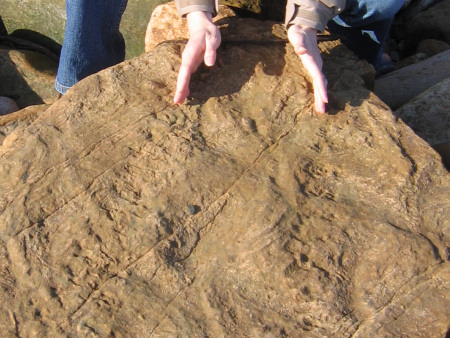
No full-body fossil has been found, but the largest was found in Germany and was 3 feet long. However, trace fossils have been left behind by an Arthropleura thought to be 5.6 feet long. Paleontologists believe that Arthropleura can reach an estimated length of at least 6.6 feet, based on fossilized fragments of specimen. (Sues, 2011)