Silurian
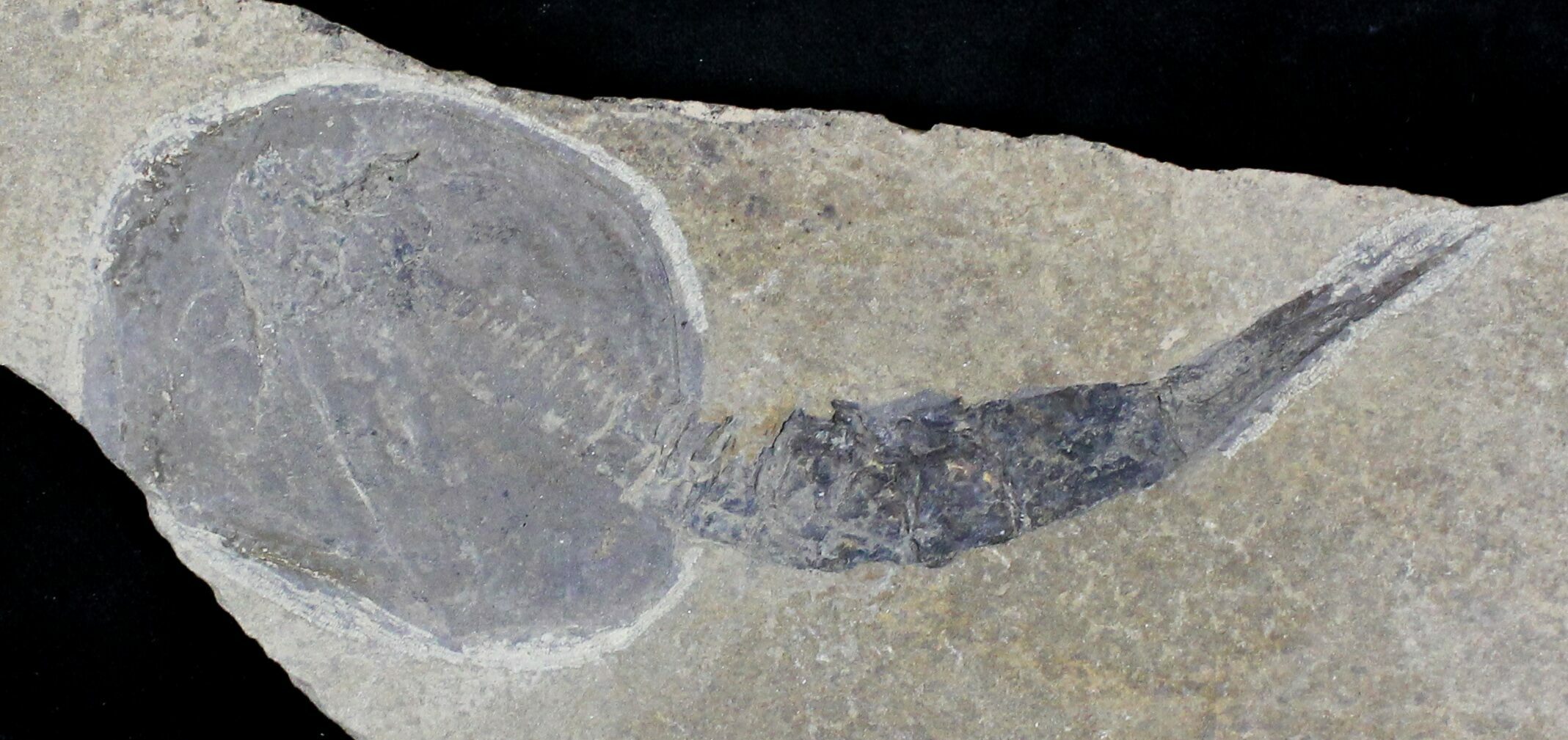
Ceratiocaris
Geological Time:
Lower Silurian Epoch; Eramosa formation
Location:
Niagara Escarpment Area , Ontario, Canada (Bolton & Copeland, 1985)
Information:
- Genus of phyllocarid crustacean
- Categorized by eight small thoracic segments, seven long abdominal somites and an elongated pretelson somite (Jones et al, 2015)
- Upper exoskeleton is oval shaped, some have ridges parallel to ventral margin
- Horn like structure at anterior end
History of the Ceratiocaris:
Geologists discovered two well-preserved species of Ceratiocaris in the Eramosa Lagerstätte in South-West Ontario. The fossils found are mostly limbs and thoracic segmentation. Ceratiocaris macroura has a longer elongated telson in comparison to its body length. This has given geologists the idea that this species was able to rapidly flex its tail, darting backwards (most likely to escape predation). Ceratiocaris papilio often preserves fine details on ridges on the abdominal. This organism had a large distribution paleo-geographically, but likely the only depositional setting that allows for the preservation is a shallow marine environment.

Ruedemannipterus
Geological time:
Upper Silurian Epoch
Location:
Southwest Ontario, Canada (as well as Northern New York)
Information:
- Genus of prehistoric Eurypterid
- Part of the family Dolichopteridae
- Popularly called “sea scorpions”
- Could have had “dual respiratory system” allowing for short time periods being spent in terrestrial environments (Manning & Dunlop, 1995)
- Some of the largest Arthropods to ever live
History of the Ruedemannipterus:
The species R. stylonuroides of the genus Ruedemannipterus has been discovered by geologists in Southwest Ontario and in New York state. It has been speculated by scientists that even though the public knowns most Eurypterids as “sea scorpions”, only the earliest ones actually lived in the marine environment (Manning & Dunlop, 1995). Later forms including R. stylonuroides were thought to live mostly in freshwater, and even some making their way to the land. However, it is thought that this species thrived in the Silurian but was heavily affected by the late Devonian Extinction event. Eurypterid population numbers/biodiversity decreased until becoming extinct after the Permian-Triassic extinction event.